Arabic
  English
  German
  Spanish
  Portuguese
  French
  Dutch
Dutch  Swedish
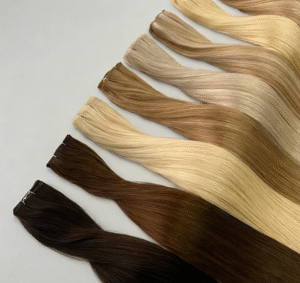
Weft hair extensions are a practical way to add length and volume without attaching individual strands one by one. A stylist can work with a wider strip of hair, which often makes the installation more efficient and gives the result a fuller appearance.
The right weft is not simply the one with the most hair. The construction, weight, attachment method, and the client’s natural hair all affect comfort and blending. This guide explains the main weft types, how they are installed, how to care for them, and what salons and wholesale buyers should check before choosing a product.
ما هي وصلات شعر اللحمة؟
A weft is a row of hair secured to a narrow base. Instead of attaching extensions strand by strand, a stylist places the weft across a section of the client’s natural hair and secures it using a suitable method.
Wefts can be grouped in two ways. The first is by construction, such as machine weft, hand-tied weft, Genius weft, and Butterfly weft. The second is by installation method, including sew-in, beaded, tape-based, and clip-in applications. These categories are related, but they are not exactly the same.
A suitable choice depends on the client’s hair density, the amount of length or volume required, the desired finish, and how much maintenance they are willing to manage.
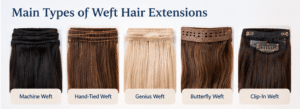
Main Types of Weft Hair Extensions
لحمة الماكينة
Machine wefts are sewn together mechanically, creating a reinforced and structured base. They are often chosen when a client needs more coverage or a stronger weft construction. They can work well for thicker hair, although the stylist should still select an appropriate weight and avoid placing too much hair on a small section.
Because the base is more substantial, a machine weft may feel heavier than a thinner design. Its main advantage is a firm structure that can be useful for certain sew-in or beaded installations.
لحمة مربوطة يدوياً
Hand-tied wefts are made by securing the hair to a thin base by hand. They are flexible and can sit close to the head, making them a popular choice when a flatter, lower-profile installation is needed.
Many traditional hand-tied wefts should not be cut through the base because the hair may loosen or the weft may unravel. Always follow the manufacturer’s cutting instructions, since construction can vary between products.
لحمة عبقرية
Genius wefts are generally designed with a thin, flat construction that gives the stylist more flexibility during installation. Some are made to be cut into smaller sections without the same risk of unraveling as a traditional hand-tied weft.
The name is used differently by some suppliers, so buyers should confirm the actual construction, cutting instructions, width, and weight before placing an order.
〈توصية بالمنتج:وصلات شعر جينيس اللحمة العبقرية〉
لحمة الفراشة
Butterfly wefts are generally designed to provide broader coverage and a fuller appearance while keeping the installation relatively flat. They can be useful when a stylist wants to build volume across a larger area without using many narrow pieces.
Because the term may describe different designs in different product ranges, check the base construction and weight rather than relying on the product name alone.
〈توصية بالمنتج: وصلات شعر لحمة الفراشة〉
Clip-In Weft
Clip-in wefts use clips to attach the hair to the natural hair. They are intended for temporary wear and can be removed after use, which makes them suitable for events, occasional volume, or clients who do not want a semi-permanent service.
Clip-in wefts are convenient, but they still need to be placed carefully. Clips that are too tight or too heavy for a small section can cause discomfort.
How to Choose the Right Weft
Choose the weft according to the client’s hair, the result they want, and the way the extensions will be worn.
- Fine or fragile hair usually needs a lighter weft with the weight spread across suitable sections.
- Thicker hair may support more coverage, but the total weight still needs to be comfortable.
- The amount needed also changes with the desired result: added fullness requires less hair than major length and volume.
- A long-term salon installation and an occasional styling solution require different attachment methods.
For salons, carrying more than one construction makes it easier to match the product to each client.
How Are Weft Hair Extensions Installed?
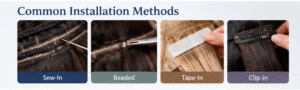
The installation method depends on the product and the result required.
Sew-In Weft
For a traditional sew-in, the stylist creates horizontal sections and prepares the natural hair, often with braids as the foundation. The weft is then sewn into place. Sectioning and tension need to be controlled so the natural hair is not placed under unnecessary stress.
Beaded Weft
Beaded wefts are secured with small beads or microbeads. This method does not require glue or heat and may allow the extensions to be removed and reinstalled. The bead size, section size, and total weight should match the client’s hair.
Tape-Based Weft
Tape-based wefts use adhesive strips to sandwich a section of natural hair between extension pieces. The attachment area needs to be clean and properly prepared for the adhesive to hold.
Clip-In Weft
Clip-in wefts are attached close to the roots with clips and removed after use. They are usually the simplest option for temporary wear, but correct placement remains important for comfort and a natural blend.
How Long Do Weft Hair Extensions Last?
Wear time and hair lifespan are not the same thing. Semi-permanent installations usually need professional maintenance after several weeks as the natural hair grows and the attachment moves away from the scalp. The schedule varies with the method, hair growth, and installation technique.
Clip-in wefts are removed after use, so they do not follow the same maintenance schedule. The extension hair itself may last much longer than one installation and can sometimes be reused several times.
Usable lifespan is shaped by hair quality, processing, heat, washing, brushing, and daily care, so a fixed time estimate can be misleading.
Can Weft Hair Extensions Damage Natural Hair?
Weft extensions are not automatically damaging, but excessive weight, small sections, tight attachments, or overdue maintenance can put stress on natural hair.
Persistent pulling, pain, or scalp discomfort should not be ignored. The installation should be checked by a trained professional, and the method or weight may need to be adjusted.
<Related Article:وصلات الشعر غير المرئية: الدليل الشامل للمشتري للحصول على شعر طبيعي وغير مرئي>
How to Care for Weft Hair Extensions

Simple maintenance helps the extensions last and keeps the natural hair comfortable.
- Wash gently and avoid rubbing the weft or attachment area.
- Apply conditioner mainly to the mid-lengths and ends.
- Brush from the ends upward without pulling on the attachment points.
- Use heat protectant, avoid repeated high temperatures, and follow the recommended maintenance schedule.
A loose braid or soft tie at night can reduce tangling. Frequent heat and chemical processing can shorten the hair’s usable life.
How Much Do Weft Hair Extensions Cost?
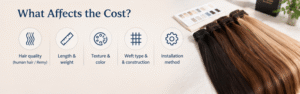
Cost is shaped by hair quality, length, weight, density, construction, color, quantity, and installation method.
For salon clients, the total price usually includes the extensions and professional installation. Maintenance and additional color or styling services may also affect the final cost.
For wholesale buyers, pricing may also depend on order quantity, packaging, custom colors, branded materials, and product development. Comparing suppliers only by price per bundle can be misleading if the specifications are different. Compare like with like and check whether the same quality can be maintained on repeat orders.
What Should Salons and Brands Look for in a Weft Supplier?
The first order is only one part of the decision. If the product performs well and customers like it, the next shipment should match the approved sample.
Before placing a larger order, ask about:
- Hair quality, available lengths, weights, textures, and colors
- Weft construction, width, cutting instructions, and attachment options
- Sample availability and whether samples represent standard production
- MOQ for standard products, custom colors, and branded packaging
- OEM or ODM support for specific specifications and product designs
- How quality issues and differences between orders are handled
A dependable supplier should explain what can and cannot be customized before production begins. Written specifications and an approved sample give both sides a clearer reference for future orders.

FAQs About Weft Hair Extensions
Are weft hair extensions suitable for fine hair?
They can be, provided the stylist chooses a lightweight construction, uses suitable sections, and controls the total weight. A lighter, flatter weft is often more appropriate than a heavy installation.
How many weft hair extensions do I need?
There is no fixed number. A stylist usually considers the client’s natural density, the desired length and volume, the width of each weft, and the amount of hair each section can comfortably support. A consultation and the product’s weight are more useful than counting pieces alone.
Can weft hair extensions be reused?
Many human hair wefts can be reused. The number of reuses varies with hair quality, construction, removal, installation, and care.
Can you cut weft hair extensions?
It depends on the construction. Traditional hand-tied wefts should generally not be cut through the base, while some newer designs are made to be cut into sections. Check the supplier’s instructions first.
Can human hair wefts be dyed?
Some human hair wefts can be colored, but the result varies with the original color, processing, and hair quality. Major color changes should be handled by an experienced professional.
الأفكار النهائية
Weft hair extensions give salons a flexible way to add length and volume without attaching individual strands one at a time. Machine, hand-tied, Genius, Butterfly, and clip-in wefts each have different constructions and uses. The right product should suit the client’s hair, the intended result, and the maintenance routine. For salons and wholesale buyers, repeat-order consistency matters as much as the first sample. A supplier that can reproduce approved specifications gives your business a steadier foundation.
If you are sourcing weft hair extensions for a salon, wholesale business, or private-label brand, مصنع الشعر اللامع can discuss samples, construction, custom colors, specifications, and packaging for your market.